
 Recently, Lithuanian airspace has faced unconventional threats – smuggling balloons arriving from neighbouring countries, which have caused real operational disruptions at Vilnius Airport. Such incidents go beyond short-term inconvenience: they directly lead to flight delays, additional costs for airlines, more expensive resource reallocation operations, and may reduce Lithuania’s attractiveness as a reliable transit country in the international market. According to official data, losses incurred by Lithuanian airports and partners today alone exceed EUR 750,000.
Practice has shown that traditional airspace surveillance systems are not designed to detect slow-moving, low-flying or non-standard objects. These technological limitations have created a need for next-generation solutions capable of identifying potential airspace violations in real time and ensuring timely response. As a result, the state announced a national competition aimed at ensuring flight safety and the uninterrupted operation of aviation infrastructure. A total of 35 teams took part, and three were awarded funding to further develop their ideas. One of them is LAVIA member Drone Team (IT Logika).
“Drone Team’s” System Could Become a Significant Boost for Lithuanian Aviation
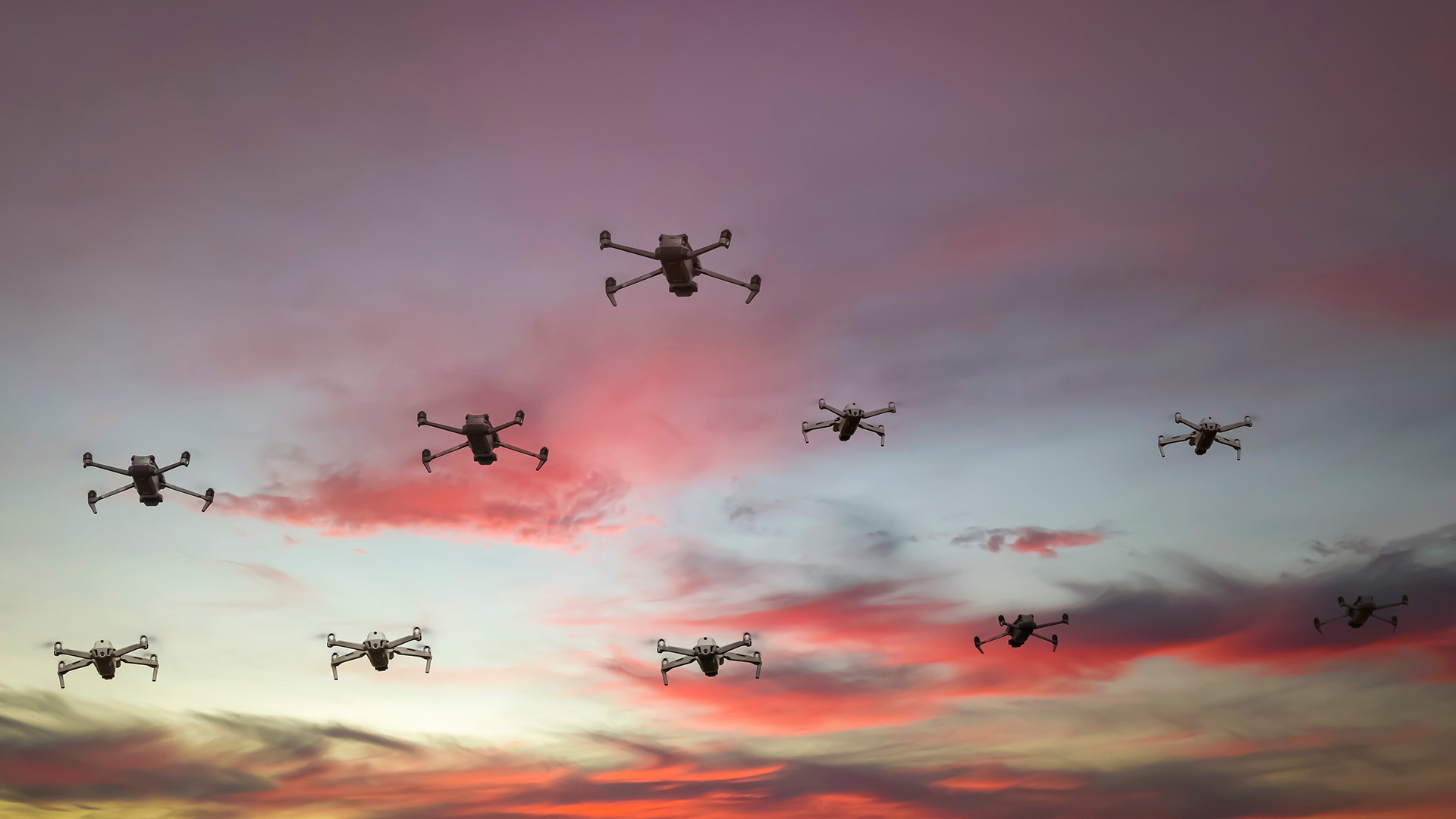
Drone Team is developing an integrated airspace protection system based on advanced interfaces between autonomous aircraft, sensors and software.
The solution consists of several key components:
- Fast low-altitude aircraft capable of rapidly responding to detected airspace violations.
- Fixed-wing aircraft capable of operating at high altitudes.
- Advanced laser-optical sensors enabling target identification in various weather conditions at any time of day.
- A high-power laser capable of neutralising a large number of balloons during a single flight.
- AI-based analytical tools capable of modelling balloon trajectories in real time.
The entire system is designed to operate continuously, 24/7, automatically detecting airspace violations and initiating actions before they cause operational disruptions. One of the key objectives of the solution is to neutralise risks in a way that avoids additional harm to the environment, people or infrastructure.
Significance for National Security
Technologies of this type are of great importance to civil aviation. They can reduce the likelihood of flight disruptions, help avoid unplanned diversions to other airports, and decrease the number of air traffic restriction cases. Integrated detection and response systems create an early warning mechanism that is critically important for both airlines and air navigation service providers.
The solution contributes to improved flight safety, operational stability and the competitiveness of Lithuanian airspace in the region. It also strengthens the state’s ability to respond to hybrid and unconventional threats, the scale of which has been noticeably increasing across Europe.
How Such Solutions Are Transforming the National Aviation Ecosystem
Airspace monitoring from a drone-based perspective is becoming one of the most advanced trends in modern aviation. Such systems are already being used for airport perimeter security, infrastructure inspection and the monitoring of high-risk areas.
The technology developed by Drone Team can be integrated with various existing national systems, including NAIS, airport operations control centres, meteorological platforms and sector-based solutions managed by air navigation authorities. This compatibility helps the entire aviation ecosystem operate more smoothly and respond more quickly to changes in airspace conditions.
These innovations also encourage closer cooperation between public authorities, aviation professionals and technology companies. This forms a necessary foundation for modern airspace protection, where technical tools must align seamlessly with regulatory, operational and safety requirements.
Lithuania’s Role in Shaping European Airspace Security Innovation
Lithuania has the opportunity to become a pilot country for testing such airspace protection systems under real operating conditions. This would provide the national aviation sector with a unique competitive advantage and give technology developers the opportunity to create solutions that could later be implemented in other European countries.
Projects such as the platform developed by Drone Team can become exportable innovation products and contribute to Lithuania’s visibility as a centre for technology and aviation innovation. This strengthens the country’s reputation, attracts investment and creates added value for both the aviation and technology sectors.
At present, the technology is entering the next testing phase, during which real-world trials will be carried out to assess system performance under operational conditions and clearly demonstrate its practical potential. These tests are a critical part of the process, enabling verification of the solution’s reliability, response speed and ability to integrate into the national aviation safety infrastructure.
We are pleased to see such strong collaboration among technology companies and their ability to respond quickly and professionally to important national-level challenges. Projects like this demonstrate that the country’s technology community is ready to contribute to national security solutions and raise aviation safety standards to a new qualitative level.